
TL;DR
If your casino runs 40+ promotions a month, the chaos you feel isn’t a staffing problem—it’s a clarity problem. Marketing with meaning means every offer has a job: to improve a specific guest moment (welcome, club sign-up, redemption friction, service recovery) and reinforce your brand promise. Cut the noise, execute fewer campaigns exceptionally well, and loyalty becomes the outcome—not the hope.
Your property runs 40+ promotions and events every month. Your team is exhausted. Your guests feel the chaos.
That’s not a staffing problem. It’s a clarity problem.
When your brand stands for something, your offers stop feeling like noise—and start feeling like proof. But here’s what’s happening in most regional casinos:
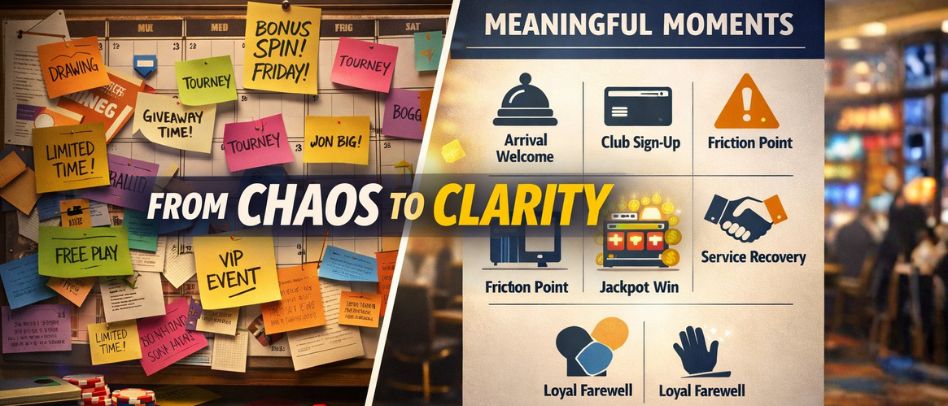
The calendar is packed. Every week brings new redemptions, giveaways, drawings, tournaments, entertainment, and “limited-time” offers. Marketing hits its numbers (or not). Operations scramble to execute. Guests show up—but they’re not building loyalty. They’re chasing deals.
Meanwhile, the moments that build loyalty—the arrival experience, the club sign-up, the first redemption, and how you handle problems—get thinner and more inconsistent, especially on your busiest nights.
Here’s the mindset shift that changes everything:
Every offer has a job, not just a due date.
When your brand means something, you don’t market just to fill the calendar. You market to change something—for the guest and the business.
And when you’re running 40+ promotions a month, that clarity becomes the difference between building a brand and just making noise.
What Marketing with Meaning Means for Casinos
If you read my post on branding with purpose earlier this year, you know that a brand’s foundation is about defining your identity—what you stand for, and the promise you make to guests and your community.
Marketing with meaning is how you execute that foundation.
Marketing with meaning is intentional marketing that reinforces who you are and makes the guest experience more consistent, human, and memorable.
It’s the difference between:
– Random acts of marketing (a promotion because it’s Wednesday) and
– Designed brand moments (promotions or events that support a specific outcome)
It’s also the difference between:
– Random acts of VIP (a host “does something nice” when they remember) and
– A consistent VIP experience (every high-worth guest feels a consistent standard of recognition, every time)
Here’s a simple example.
A standard promo might be: “Get $10 in free play when you earn 25 points.”
A meaning-driven version might be: “Bring-a-friend night designed to introduce new guests to the Player’s Club, create a natural host touchpoint for emerging VIPs, and build a repeat visit within 10 days.”
The mechanics might look similar. The job is totally different. And that job—the specific outcome you’re designing for—is what transforms a promotion from calendar filler into a brand-building moment.
The Three Questions Every Casino Promotion Should Answer
Before you green-light anything—promotion, event, mailer, SMS, giveaway—run it through these three questions.

1) Who is this really for? Not “all carded players.” Not “everyone.”
Meaningful marketing starts with specificity.
Examples:
- Weekday locals who haven’t visited in 60–180 days
- First-time sign-ups in their first 30 days
- High-frequency guests hovering just below a tier threshold
- Hosted players who visit quarterly but carry high ADT potential
- Un-carded retail guests who attend entertainment but never join the club
When you get the audience right, everything gets easier: offer design, messaging, staff execution, and measurement.
2) What do we want them to think, feel, and do?
This is where promotions stop being “stuff we run” and start becoming “experiences we design.”
For example, if your target is a lapsed mid-worth guest, you want them to:
- Think: “They noticed I’ve been gone.”
- Feel: “I’m missed, not just marketed to.”
- Do: “Come back within the next 10 days and re-engage.”
Or for a new member:
- Think: “This is easy to understand.”
- Feel: “I’m welcomed, not overwhelmed.”
- Do: “Take two actions this month (earn points + redeem something small).”
When a campaign has no Think/Feel/Do, it’s usually just a discount with a deadline.
3) How does this connect back to our brand promise?
This question is the one most calendars skip, and it’s where the damage happens.
A property can talk about being “premium,” but run chaotic, high-friction redemption mechanics.
A property can claim to be “welcoming,” but let new guests wander without orientation.
A property can talk about “community,” but make the on-property experience feel transactional.
Your brand promise isn’t your tagline. It’s what your guest experiences repeatedly.
If a campaign reinforces that promise, it builds trust. If it contradicts it—even slightly—it erodes trust faster than you think.
Meaning is Built in Moments—Not in Marketing Copy
Guests don’t remember your campaign name.
They remember moments.
They remember how it felt when they walked in.
How confusing (or easy) the club sign-up was.
How they were treated after a jackpot.
How a minor problem was handled.
Whether anyone made them feel seen.
Marketing with meaning works best when it improves the moments that shape the guest’s story.
And when you’re running 40+ promotions a month, you don’t have bandwidth to improve every touchpoint at once. You need to focus on the moments that matter most.
The Moments Map: Seven Guest Moments That Drive Loyalty
You don’t have to fix everything at once. Start by mapping the moments that matter most:
- Arrival & welcome (first 90 seconds)
- Guest question: “Do I belong here?”
- Your behaviors: acknowledge, orient, clarity
- Proof to market: “Here’s how we welcome first-timers/regulars.”
- Player’s Club decision (join or stay un-carded)
- Guest question: “Is this worth it—or is it a hassle?”
- Your behaviors: explain in plain language, make the first win easy
- Proof to market: “Join today, use it today” stories.
- Friction moment (kiosk, promo redemption, lines, confusion)
- Guest question: “Why is this so hard?”
- Your behaviors: remove friction before it becomes frustration
- Proof to market: “We make it easy” is believable only when it’s experienced.
- First big emotion (first win—or first rough loss)
- Guest question: “How do they treat me when it’s not perfect?”
- Your behaviors: respect, encouragement, calm professionalism
- Proof to market: not the loss—your consistency and humanity.
- Food & beverage reality check (service + comp clarity)
- Guest question: “Is this worth my time and money?”
- Your behaviors: transparency, proactive guidance, service recovery
- Proof to market: hospitality that matches the brand.
- Jackpot / handpay moment
- Guest question: “Is this celebrated? Is it handled with care?”
- Your behaviors: celebrate without chaos, protect privacy, make it feel special
- Proof to market: authentic winner stories (with permission), staff pride.
- Service recovery moment (the save-or-lose moment)
- Guest question: “When something goes wrong, do they own it?”
- Your behaviors: fix fast, follow through, make it right without a fight
- Proof to market: not the issue—the response.
A campaign earns its place on the calendar when it reinforces one or more of these moments.
Properties that improve just 2–3 of these moments should consistently see measurable lifts in visit frequency, average spend per visit, and Player’s Club enrollment quality within 90 days.
The rest of the calendar? It’s creating work without creating value.
Employees Are the Translation Layer
This is the point at which marketing with meaning becomes a leadership topic, not just a marketing one.
Because meaning doesn’t scale through slogans.
Meaning scales through employees who understand what the brand stands for—and how to deliver it in real time.
Operationally, this means that when frontline teams understand the why behind a campaign, you get fewer manager calls. Faster service recovery. Less pre-shift confusion. Better execution on your busiest nights.
When they don’t? You get the same three questions at every huddle, inconsistent execution across shifts, and frustrated team members who feel like they’re just “checking boxes” instead of creating experiences.
Over time, that’s how you lose your best hosts and supervisors—not to better pay, but to operational chaos that feels meaningless.
If frontline teams can’t explain why a promotion exists, it’s usually a sign that the promotion isn’t meaningful enough yet.
Turn Values into 3–5 Non-Negotiable Behaviors
Pick a simple meaning statement (one sentence). Then translate it into behaviors employees can do.
For example, if your meaning is: “We make locals feel seen.”
Your non-negotiables might be:
- Notice: acknowledge regulars and welcome first-timers
- Explain: reduce confusion around points, comps, and how promotions work
- Own it: fast service recovery with clear authority to make it right
- Celebrate: make wins feel human and memorable, not transactional
- Protect: support responsible gaming in a respectful, consistent way
(That last one matters. In the long run, protecting guests is part of a brand that truly means something—not just a compliance checkbox.)
The Simplest Internal Tool That Changes Execution
Before every meaningful campaign, give the team a one-page brief:
- Who it’s for
- What we want guests to think/feel/do
- Which moment(s) we’re improving
- What to say when guests ask questions
- What to do if something goes wrong
Then reinforce it with a 60-second pre-shift huddle:
- “Today’s campaign exists to ______.”
- “The moment we’re owning is ______.”
- “The behavior we’re coaching is ______.”
That’s how you turn “marketing” into a consistent experience.
Doing Less, Execute Better: Editing the Casino Marketing Calendar
Doing less is one of the hardest lessons in casino operations:
The pressure to “fill the board” is real. Corporate wants activity. The marketing team has ideas. Partners want placement. There’s always another slot manufacturer with a co-op offer, another local business wanting a cross-promotion, another reason to add “just one more thing.”

But a full calendar doesn’t automatically produce a strong brand or quarter. It creates promotional noise that trains guests to ignore you.
When you’re running 40+ promotions and events a month, you can’t create the moments that matter. Your team is too busy executing to deliver consistently. Your brand message gets buried, and your best campaigns—the ones that could truly move behavior—get lost in the noise.
Meaningful marketing is often the discipline to edit the calendar—so you can execute what remains with clarity and impact.
Here’s what I tell marketing directors and GMs who are ready for this shift:
You don’t need board approval to cut a low-performing giveaway next month.
You don’t need a consultant to eliminate a promotion that creates more labor than loyalty.
You don’t need permission to say: “We’re going to focus on fewer campaigns executed exceptionally well.”
What you do need:
- Clarity on what you’re optimizing for (frequency? reactivation? tier velocity? new-to-file conversion?)
- A Meaning Filter that everyone trusts (more on that below)
- The courage to disappoint the internal stakeholders who mistake activity for strategy
What to Cut (and What to Double Down On)
A practical example:
Cut three low-impact, high-labor giveaways that staff dreads and guests barely remember.
Redirect that energy into:
- Improving the arrival and club sign-up experience for first-timers
- Building one repeatable midweek event that grows month over month
- Training service recovery behaviors that protect your reputation on your busiest nights
Doing less isn’t a retreat. It’s a strategy.
And it’s kinder to your team—because meaning should be internal too. A calendar that overwhelms operations rarely creates a meaningful guest experience.
Key Takeaways
- Every offer needs a job, not just a due date.
- Start with three questions: who it’s for, what you want them to think/feel/do, and how it supports the brand promise.
- Guests remember moments, not campaign names—focus on the moments that decide loyalty.
- A campaign earns its place when it improves at least one “Moment That Matters.”
- Employees are the translation layer—meaning scales through behaviors, not slogans.
- Do less, execute better: edit the calendar until execution is consistent on busy nights.
- Use the Meaning Filter to protect your team from promotional chaos and protect your brand from noise.
Meaningful In the Micro: Small Touches, Big Signals
You don’t need a budget increase to make marketing more meaningful. You need to pay attention to the small signals that guests notice instantly.
A few guest-facing examples:
- A welcome email that doesn’t just list offers but says: “Here’s how to make the most of your first month with us.”
- A first-visit follow-up that feels like recognition, not automation.
- A host sending a short personal note after a first VIP event: “Loved meeting you—next time, I’ll make sure you try ____.”
And internal examples that change execution quality:
- A one-page “why this matters” brief for every major campaign
- Simple training on what “good” looks like for each Moment That Matters
- Recognition for employees who create the moments—not just for speed or upsell
Small touches become big signals. Big signals become brand.
The Meaning Filter Checklist
Before you green-light a campaign, ask:
- Who is this really for?
- What do we want them to think, feel, and do?
- How does it reinforce our brand promise?
- What problem does it solve—for the guest and for us?
- If we didn’t run it, what would actually happen?
- Can we execute it well with the staff we have?
- Which Moment That Matters does it improve?
- Are we proud to put our name on it?
If those answers aren’t clear, don’t rush into production. Refine it until it earns its place.
This filter isn’t about being rigid. It’s about being intentional. And it’s about protecting your team from the kind of calendar chaos that burns people out and dilutes your brand.
The Quiet Power of Meaning
The most successful regional casinos aren’t the ones doing the most. They’re the ones doing more of what matters—with consistency, clarity, and operational follow-through.
Marketing with meaning isn’t about being sentimental. It’s about being intentional.
It’s about designing campaigns that improve the moments guests remember—and giving employees the clarity to deliver those moments every shift, every night, even when it’s busy.
It’s about having the discipline to say no to promotions that clutter your message so you can say yes to the experiences that build your brand.
If you want to try this for next quarter, here’s the most straightforward path:
- Choose one meaning statement that defines who you are
- Identify three moments from the map that you’ll improve
- Define two behaviors per moment that employees can deliver
- Audit your Q1 calendar against the Meaning Filter—and edit until what remains supports that focus
That’s how a brand becomes real. That’s how loyalty compounds. And that’s when marketing stops feeling like a treadmill and starts feeling like a system.
FAQs
What’s the fastest way to tell if a promotion is “meaningful”?
If you can’t clearly explain what it changes for the guest and the business, it’s probably calendar filler.
How many promotions should a regional casino run per month?
There’s no magic number—run only what you can execute well. Most properties improve results by cutting low-impact, high-labor promotions and doubling down on fewer, more straightforward campaigns.
Which guest moments should we prioritize first?
Start with the highest-friction, highest-volume moments: arrival/welcome, players club sign-up, redemption friction, and service recovery.
How do we align frontline teams without overtraining?
Use a one-page “why this matters” brief and a 60-second pre-shift huddle tied to one moment and one behavior.
What if corporate requires a full calendar?
Keep the activity—but tighten the definition of success. Use the Meaning Filter to standardize what gets approved and what gets cut.
How do we measure “marketing with meaning” beyond “we got some play”?
Track leading indicators (sign-up conversion, complaint resolution time, redemption friction) and lagging indicators (return visits, offer efficiency, frequency lift).
Does this apply to VIP/hosted players too?
Yes—especially. “Random acts of VIP” create inconsistency; meaningful VIP is a repeatable standard of recognition.
Recent Comments