
For a long time, casino marketing was a direct-response game with a clear rhythm. You built a database, segmented it, sent offers, drove trips, measured redemption, and repeated. In most regional markets, that approach worked because it matched the reality of the moment. Competition was simpler. Consumer options were fewer. Digital hadn’t yet shaped expectations the way it does now. Guests were less trained to shop offers across multiple properties. And many operators were still moving from instinct-driven marketing to measurable marketing. So, database discipline alone felt like a breakthrough.
But here’s what changed: guests learned. They learned how to rotate properties, treat offers like coupons, and figured out exactly which incentives stack and which ones don’t. Some segments — especially high-frequency guests — became remarkably good at maximizing benefits while minimizing commitment. Meanwhile, operators doubled down on the mechanics: more offers, more events, more complexity.
And now, many marketing teams are busy but not in control.
So, yes, the old playbook still “works” in the narrow sense that offers can still drive response. But it often drives response without building preference. And response without preference is expensive, fragile, and easy for a competitor to steal.
That’s where the “what if everything you knew was wrong?” question becomes useful: not as a hot take, but as a practical challenge:
What if you’ve been optimizing what’s easy to measure (redemption, attendance, response)… instead of what actually grows profitable demand (preference, retention, share of trips, and sustainable frequency)?
Why the Old Playbook “Works” (But Still Loses on Margin)
Let’s unpack the most common assumptions that keep teams trapped in tactics-first marketing.
TL;DR:
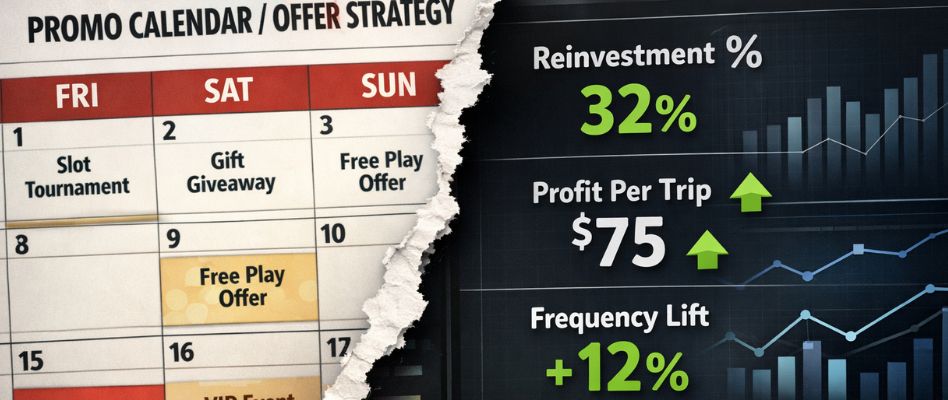
Casino marketing still “works”, but too often it drives response without building preference. That’s how you end up with strong redemption, a packed calendar, and a shrinking margin. The fix is a preference-led system: make reinvestment earn incremental behavior, measure beyond redemption (profit per offer, reinvestment% by segment, frequency lift, conversion), and treat the calendar as a revenue instrument—not the strategy.
The 7 “Casino Marketing Truths” That Might Be Wrong
Over time, casino marketing has accumulated a set of assumptions that stopped being questioned. They got passed down, built into systems, and eventually treated as facts. They shape calendars, justify reinvestment decisions, and set the bar for what “a good month” looks like.
Here’s the problem: most of them were built for a market that no longer exists.
Myth 1: More reinvestment means more loyalty
Why we believe it: Because reinvestment does influence behavior, a strong offer can motivate a trip. A comp can smooth a decision. A reward can create a genuine feeling of being valued. And in the early years of database marketing, increasing reinvestment often led to more visits, so the association felt earned.
What it causes: When reinvestment becomes your default lever rather than a strategic one, you stop earning behavior and start renting it. Guests learn to wait for the incentive. You reward the most offer-sensitive players, who are rarely your most profitable ones. And margin compresses, slowly at first, then noticeably.
At the extreme, you build a guest base that is loyal to the deal, not the property. That’s a fragile business. Deals can always be matched.

What to do instead: Reinvestment should earn something specific: an incremental trip, improved ADT stability, recovered lapsed behavior, or share-of-wallet protection in a competitive pocket. The goal isn’t lower reinvestment as a matter of principle. The goal is disciplined reinvestment that produces incremental, profitable behavior — not subsidized baseline behavior.
A quick metric check: If reinvestment goes up but trips don’t rise proportionally, profit per trip declines, or redemptions climb without ADT movement, you’re not building loyalty. You’re buying attendance.
Myth 2: High redemption means the campaign was successful
Why we believe it: Because redemption is visible, reportable, and feels like proof that marketing did something. When leadership asks, “How did the promotion do?” and you can point to a strong redemption number, the meeting moves on. That feedback loop can train teams to optimize for the metric that ends the conversation.
What it causes: The campaign debrief stops at “Did they show up?” — which is the least interesting question. The more important questions don’t get asked: Did they show up profitably? Did anything change about their long-term behavior? Did we generate an incremental trip, or did we subsidize one that was going to happen anyway?
High redemption can signal a healthy program. It can also signal that your offer is too rich, too frequent, or too easy to game. Without digging deeper, you can’t tell the difference.
What to do instead: Shift the definition of success from response to incremental contribution. That means pairing redemption data with profit per redeemed trip, incremental theo, and cannibalization signals, like whether non-offer play drops on adjacent days when a strong offer is in market.
A quick metric check: If the redemption number is strong but incremental profit is flat or negative, you have a popular promotion that isn’t growing your business. That’s worth knowing before you run it again.
Myth 3: If we send more offers, we’ll get more visits
Why we believe it: Because volume often does increase response, especially in the short term, and when you’re under pressure to drive trips, more outreach feels like action. It’s tangible. It’s measurable. And early in a database program’s life, it’s usually true.
What it causes: Over time, more offers produce diminishing returns and compounding problems. Guests develop fatigue. The calendar bloats. The team lives in a permanent sprint. And the offers themselves lose meaning because if something is always available, it stops feeling like a reason to act.
There’s a subtler problem, too: when every week has a promotion and every weekend has an event, you stop giving guests a clear reason to choose you. You’re just adding to the noise. And the only way to be heard in a noisy environment is to spend more.
What to do instead: Build fewer, clearer reasons to visit. Then, engineer them around your best segments and your actual capacity. The win isn’t “more offers.” It’s offers that are easy to understand, hard to replicate, and genuinely aligned with the guests you’re trying to grow.
A quick metric check: Look at visit frequency by segment. If your high-frequency guests aren’t increasing trips despite more offers, you’re likely feeding saturation, not preference. More is not the answer.
Myth 4: The database is the business
Why we believe it: Because rated play is measurable, direct marketing is trackable, and the database is where most casinos get the majority of their trip-driving horsepower. When something is easy to see and easy to act on, it naturally becomes the center of gravity.
What it causes: A blind spot. You over-invest in what you can measure and under-build what creates new demand. Uncarded guests are often your lowest-reinvestment revenue and also your next wave of rated growth, if you give them a compelling reason to join and a frictionless path to do so.
When the database becomes synonymous with “the business,” uncarded growth becomes an afterthought. New member signups flatten. The funnel narrows. And eventually, you’re marketing harder to a smaller, aging pool.
What to do instead: Treat the database as a powerful asset, but not the ceiling of your growth. Preference is built in the experience layer: how easy it is to park and navigate, how long redemption takes, how recognized guests feel, and how consistent the property is across visits. Direct marketing amplifies that preference. It can’t create it.
A quick metric check: Track new member signups, unrated-to-rated conversion, and first-to-second trip conversion for new members. If you’re not measuring the funnel, you can’t see where it’s leaking.
Myth 5: Hosts are only for the biggest players
Why we believed it: Because hosted programs are expensive and host time is genuinely limited. Concentrating that resource on the highest-worth relationships feels like the rational play, and in a pure ROI-per-touch calculation, it often is.
What it causes: Hosts become reactive rather than strategic. They spend their time managing established relationships rather than building emerging ones. The “almost there” guest — high frequency, growing worth, not yet hosted — gets no attention until they’re already drifting. By then, intervention is more difficult, and recovery is more costly.
In many properties, there’s a meaningful segment of guests who could be tomorrow’s top value if someone guided them today. When hosting is reserved only for guests who’ve already arrived, you miss that window entirely.
What to do instead: Use hosting as a pipeline strategy, not just a retention tool. That means identifying emerging worth patterns early, intervening when behavior changes rather than after it has, and treating the host relationship as preference-building rather than comp administration. The host who catches a lapse at 30 days is more valuable than the one who responds at 90.
A quick metric check: Measure pipeline movement: how many guests move up a tier over a rolling period, reactivation success rates, and recovery rates after a lapse trigger. If you can’t see movement, you can’t manage it.
Myth 6: Omnichannel means being everywhere.
Why we believed it: Because more channels feel like more coverage. And when digital options multiplied — email, SMS, app, social, digital display, kiosk — adding channels looked like progress. The logic made sense: reach guests wherever they are.

What it causes: Dilution, inconsistency, and wasted effort. A property can run mail, email, SMS, social, digital ads, app pushes, onsite signage, and host outreach, yet still feel incoherent because each channel operates on its own cadence with its own message. The guest experiences it as noise rather than conversation.
The deeper problem is that omnichannel without sequencing creates a false sense of sophistication. You feel covered. But coverage isn’t connection.
What to do instead: Think in sequences, not channels. Mail anchors the core message and value proposition for key segments. Digital accelerates response through reminders and urgency. On-property reinforces and converts the visit into ongoing behavior. Every channel should sound like the same brand talking to the same person, not five departments shouting different things in the same week.
A quick metric check: Look at assisted response: the lift you get when mail and digital work together versus either alone. If you’re not measuring it, you’re guessing at what’s actually driving trips.
Myth 7: A promotions calendar is a strategy
Why we believed it: Because the calendar is the most visible output of marketing, it’s what leadership sees, what operations plans around, and what the team executes. If the calendar is full, marketing appears to be working.
What it causes: The calendar becomes the plan, and when the calendar is the plan, decisions get made by habit, vendor relationship, and competitive reaction rather than by intent. Teams scramble to fill dates. Events repeat because they repeated last year. And “strategy” becomes whatever fits in the next available weekend.
The deeper problem is that a busy calendar can mask a strategic void. If every month has something going on, it’s easy to feel like you’re going somewhere when you’re really just moving.
What to do instead: Treat the calendar as the output of strategy rather than as the strategy itself. Before a single date gets placed, the strategy should answer four questions:
- Who are we trying to grow?
- What do we want to be chosen for in this market?
- What can we deliver consistently that competitors can’t easily copy?
- And — critically — what are we going to stop doing?
That last question is often where the most value hides. Most calendars grow by addition. The discipline is subtraction: fewer events, cleaner reasons to visit, and enough white space that the things you do promote actually stand out.
A quick metric check: If you can’t explain your marketing strategy in three sentences, your calendar is probably trying to do it for you and failing. The test isn’t whether the calendar is full. It’s whether every item on it is earning its place against a clear goal.
The Replacement Model: Preference-Led Casino Marketing
If the old playbook is “optimize offers,” the replacement model is:
Build preference first, then use offers to amplify it.
That doesn’t mean you stop doing promotions or direct marketing. It means you stop letting tactics become the strategy.
Here’s a practical framework you can use to rebuild your approach without drowning in complexity:
Position: Decide what you’re trying to own
Not “something for everyone.” In a competitive market, you need clarity.
- What is your property known for—consistently?
- What can you deliver better than competitors (experience, value, energy, service, entertainment, convenience)?
- What do you want the guest to believe about you before they ever see an offer?
If you’re unclear here, every campaign becomes a guessing game.
Prioritize: segment goals and reinvestment rules
Segments are not just worth tiers. They’re behavior patterns. The key is building rules that fit each group:
- Hosted players: protect share, deepen relationship, reduce drift
- High-frequency high-worth: recognition plus discipline, prevent cherry-picking
- Mid-worth regulars: steady cadence and progress, avoid confusing clutter
- Low-worth frequent: margin protection with boundaries
- Retail un-carded: conversion design and low-cost onboarding
Each segment needs its own “definition of success.”
Program: build a calendar that drives the outcomes you want
A great calendar is not a collection of weekends. It’s a plan that:
- creates reasons to visit that are clear and distinct,
- uses cadence to shape habit,
- and aligns with your operation (capacity, staffing, redemption flow).
Prove: measure what changes decisions
If your KPIs don’t change decisions, they’re reporting, not management.
Preference-led marketing measures:
- incremental profit (not just response),
- frequency lift by tier,
- retention and reactivation,
- new member and unrated-to-rated conversion, and
- reinvestment discipline by segment.
That’s the system. Now let’s make it real.
Monday-Morning Moves by Segment
Hosted players: high worth, infrequent
Goal: protect share of wallet and reduce drift.
Move: Build “planned trips,” not reactive comps. When you know a guest’s preferred rhythm, you can pre-commit experiences and reduce competitor rotation.
Offer discipline: comps should be tied to planned incremental behavior and experience value, not blanket generosity.
KPIs: reactivation rate, trip planning success, share-of-visits, ADT stability.
High-frequency, high-worth (not always hosted)
Goal: build preference so they stop shopping the market.
Move: replace “constant incentives” with recognition and progress. These guests don’t need another coupon. They need a reason to believe you’re their place.
Offer discipline: avoid stacked offers that reward cherry-picking. Use fewer, clearer reasons to visit.
KPIs: visits/month, theo/trip, retention, cross-sell adoption.

Mid-worth regulars
Goal: grow frequency and protect emotional attachment.
Move: simplify the value story. Make it easy to understand how to win with you (points, tiers, benefits).
Offer discipline: “one reason to visit” offers that create a clean habit loop.
KPIs: frequency lift, retention, profitable redemption.
Low-worth frequent
Goal: protect margin while managing expectations.
Move: transition from cash-heavy value to experience-heavy value (priority lines, occasional surprise, service consistency).
Offer discipline: cap reinvestment, reduce complexity, stop subsidizing unprofitable behavior.
KPIs: reinvestment %, profitability by segment, service friction impact.
Retail un-carded guests
Goal: capture and convert without heavy reinvestment.
Move: design irresistible signup moments: easy, fast, and meaningful. Then build a simple bounce-back that gets a second trip.
Offer discipline: low-cost conversion first; then nurture into the mid-worth journey.
KPIs: new signups, first-to-second trip rate, unrated-to-rated conversion.
Your Calendar Isn’t a Calendar. It’s a Revenue Instrument.
If your team feels overwhelmed, the calendar is usually the culprit, not because you have “too many events,” but because the calendar isn’t built from a strategy.
Most calendars are a mix of:
- habits (“We always do this in March”),
- vendor-driven ideas,
- competitor reaction,
- internal politics,
- and a lot of “seemed like a good idea at the time.”
The result is activity without direction.
Here’s a cleaner way to build it:
The 3-Layer Calendar Model
- Anchor moments (monthly or quarterly): Big, distinct reasons to visit that reflect what you want to own in your market.
- Segment cadence: A consistent rhythm by tier that shapes behavior without constant novelty.
- Operational reality: Capacity, staffing, redemption flow, and host bandwidth aren’t “constraints.” They’re the difference between a promo that works and a promo that breaks trust.
- A simple sanity rule: If every weekend is a promotion, none of them are.

KPI Reset: Measure What Matters (and Stop Rewarding the Wrong Wins)
You don’t need a hundred metrics. You need the handful that change decisions.
Keep these—but use them as diagnostics
- Redemption rate (a signal, not a trophy)
- ADT (watch stability and lift, not just averages)
Add or elevate these
- Incremental profit per offer
- Reinvestment % by segment
- Frequency lift by tier
- Retention/reactivation rates
- New member signups
- Unrated-to-rated conversion
- Host pipeline movement
If your KPI dashboard is built around “how busy we were,” you’ll keep making decisions that create busyness.
If your dashboard is built around “what grew profitable preference,” you’ll start building a business you can steer.
Key Takeaways
-
Redemption is a signal, not a trophy. Pair it with incremental profit and look for cannibalization.
-
Reinvestment isn’t loyalty—it’s leverage. If it’s your default, you’re renting behavior. Make it earn incremental trips, ADT stability, reactivation, or share protection.
-
More offers don’t automatically create more visits. They often create fatigue, calendar bloat, and “always available” promotions that kill urgency.
-
The database is an asset, not the ceiling. Uncarded guests are low-reinvestment revenue and your future rated pipeline—if you measure conversion.
-
Omnichannel isn’t everywhere. It’s sequenced. Mail anchors, digital accelerates, on-property reinforces—one message, one reason-to-visit.
-
A packed promo calendar can hide a strategy problem. The discipline is subtraction—fewer, clearer reasons-to-visit that match segments and capacity.
-
If KPIs don’t change decisions, they’re just reporting. Reset the scoreboard around incremental profit, reinvestment by segment, frequency lift, and conversion.
What Gets in the Way — And Why It Doesn’t Have To
“But our market is promotions-driven.”
It probably is. Most regional markets are. And that’s precisely why discipline matters more here than anywhere else.
When every property in your market is running promotions, the offer itself becomes less of a differentiator. Your guests already know how to work the system: they rotate, they redeem, they move on. If your only answer to that behavior is more promotions, you’re not competing. You’re participating in a race where nobody wins on margin.
The goal isn’t to stop promoting. It’s to stop promoting randomly without a clear segment in mind, without a measurable definition of success, and without asking whether this event earns its place on the calendar or just fills a date.
“My team is already stretched.”
That’s not an argument against strategy. That’s the strongest argument for it.
Stretched teams don’t suffer from too much focus. They suffer from too little. When there’s no clear filter for what matters, everything feels urgent, and nothing gets done well. Every new idea gets added. Nothing gets cut. The calendar fills up not because the strategy demands it, but because nobody has the clarity—or the permission—to say no.
A tighter strategy doesn’t create more work. It creates a shorter list of the right work. And that’s the only thing that actually reduces the pressure your team is already feeling.
The Reset You’ve Already Started
If you’ve read this far, something in here landed. Maybe it was the reinvestment myth. Maybe it was the calendar section. Maybe it was the uncomfortable recognition that your team is busy in exactly the way this post describes.
That recognition is useful. It’s not an indictment of your team or your work. It’s a signal that the market moved, and the playbook needs to catch up. That’s not a failure. It’s the norm in any competitive environment. The teams that pull ahead aren’t the ones that never inherited bad assumptions. They’re the ones who identified them and built something better.
You don’t need a reinvention. You need a reset:
From tactics-first to strategy-led. From buying trips to building preference. From a calendar that explains your strategy to a strategy that drives your calendar.
The framework is here. The segment playbooks are here. The KPIs are here. What turns all of it into results is execution, and execution is where most good intentions stall.
That’s the next step. And it’s closer than you think.
You Don’t Need More Tactics—You Need a System
If this post made you slightly uncomfortable, good. That discomfort is the gap between what you’ve been optimizing (response) and what you actually want (preference and profit).
Most casino teams aren’t short on ideas. They’re drowning in ideas.
What they’re missing is a repeatable operating system:
- how to set priorities,
- how to design a calendar that drives outcomes,
- how to set reinvestment rules that protect margin,
- and how to run direct marketing that builds preference instead of just buying traffic.
That’s what Casino Marketing Boot Camp is designed to do—turn the “we should” into a plan your team can run.
Choose the track that fits your reality
Strategy & Planning (Tulsa | 3 days): Build your marketing plan + calendar
If you want the full rebuild—strategy, segmentation priorities, calendar architecture, and execution rhythm—this is the option built for leaders who want a complete marketing plan and a calendar they can defend and deploy.
Direct Marketing (Des Moines | 2 days): Tighten offers, segmentation, cadence, and profitability
If a three-day commitment isn’t realistic right now, this is the fastest path to fixing the part of the playbook that often creates the most waste: offer strategy, direct marketing discipline, and the sequencing that turns outreach into profitable trips.
Your Next 3 Moves (If You Want This to Actually Change Anything)
- Pick one myth you’re currently funding (start with reinvestment or calendar bloat) and define what “incremental success” means—one metric beyond redemption you’ll use to judge it.
- Choose one segment to protect or grow this quarter (hosted drift, high-frequency high-worth, mid-worth retention, or new-member conversion) and align offer cadence + host/digital touches to that single outcome.
- Cut one thing from the calendar in the next 30 days so what remains can actually stand out—then measure whether that subtraction improves frequency lift, profitability per offer, or reinvestment %.
FAQs
What’s the difference between an incremental trip and a subsidized trip?
An incremental trip is a visit that likely wouldn’t have happened without the offer. A subsidized trip is a visit that was already going to happen—your offer just discounted it. The goal isn’t “high redemption,” it’s incremental profit tied to incremental behavior.
How do I know if my promotions are cannibalizing play?
Watch what happens before and after the offer window. If you see a spike on promo days and a dip on adjacent days (or lower non-offer play), you may be shifting demand—not growing it. Pair redemption with profit per redeemed trip and simple cohort comparisons.
What KPIs should casino marketers track beyond redemption and ADT?
Keep redemption and ADT as diagnostics, but add: incremental profit per offer, reinvestment% by segment, frequency lift by tier, retention/reactivation, and new member + unrated-to-rated conversion. Those metrics change decisions and protect margin.
How do I reduce reinvestment without losing trips?
Don’t “cut offers.” tighten rules. Make reinvestment earn specific outcomes (incremental trips, ADT stability, reactivation, share protection), remove stacked/always-on value that trains cherry-picking, and simplify the calendar so fewer promotions stand out more.
How do I build a casino promo calendar that actually drives profitable trips?
Start with strategy: who you’re growing, what you want to be chosen for, what you can deliver consistently, and what you’ll stop doing. Then build a 3-layer calendar: anchor moments, segment cadence, and operational reality (capacity, redemption flow, staffing).
Recent Comments